
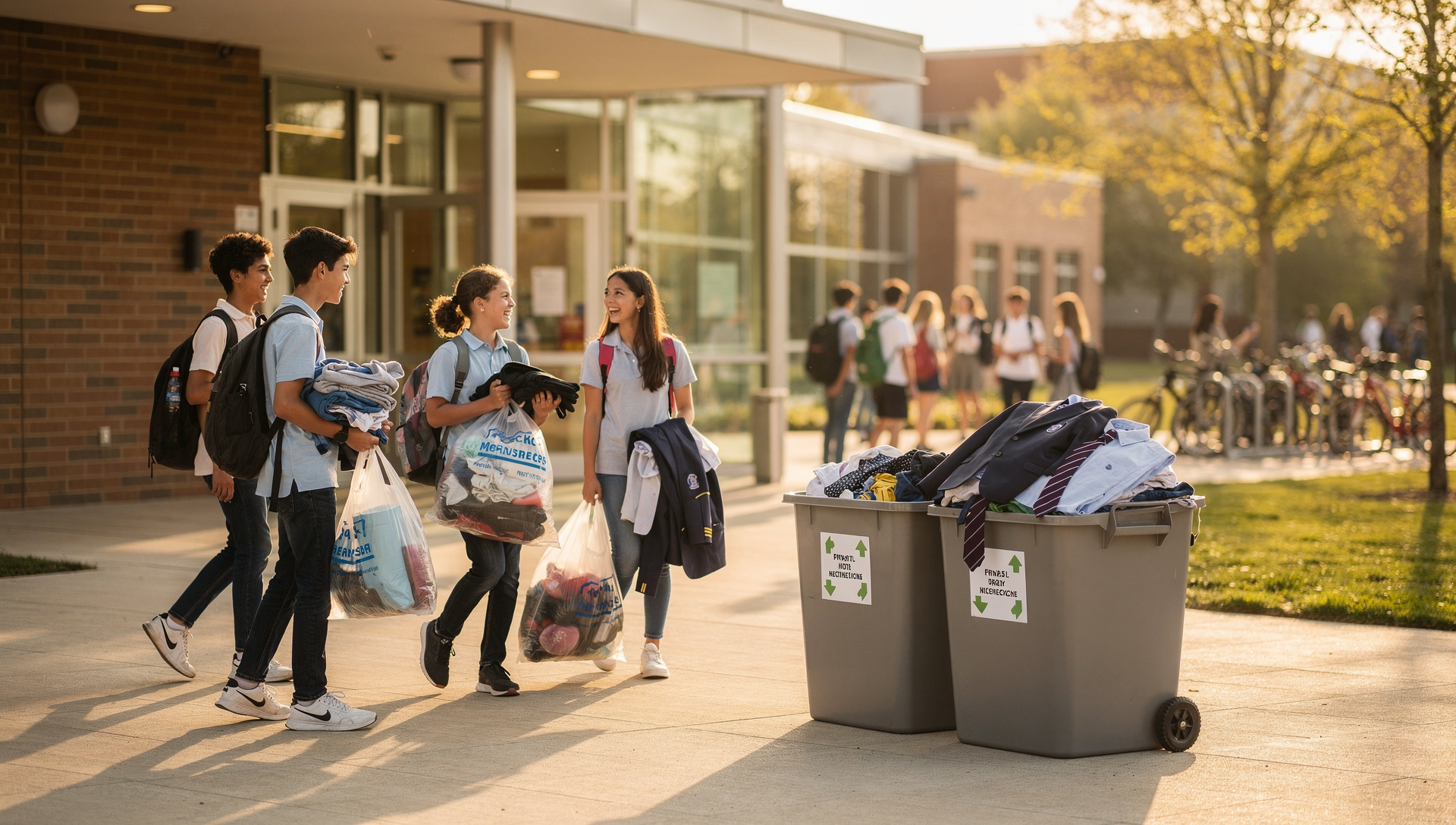
School uniform recycling represents one of the most straightforward opportunities for educational institutions to reduce waste and demonstrate environmental responsibility. With the average UK secondary school generating approximately 2.5 tonnes of textile waste annually from discarded uniforms, implementing effective recycling systems has become a priority for forward-thinking schools.
For school leaders evaluating their sustainability policies, uniform recycling offers measurable benefits: reduced disposal costs, support for families facing financial pressures, and tangible progress towards net-zero commitments. This guide examines practical approaches to establishing and maintaining successful recycling programs within educational settings.
Understanding School Uniform Recycling Options
Schools face distinct challenges when recycling uniforms compared to standard textile recycling. Branded items with school logos require secure disposal methods to protect institutional identity, while ensuring donated items meet safety standards. Three primary recycling routes exist for educational institutions.
Internal recycling schemes allow schools to collect, sort, and redistribute uniforms directly to families within their community. These programs typically operate through parent associations or dedicated volunteers who manage collection points and organize distribution events. Schools retain complete control over their branded items while supporting families who need affordable uniform options.
External partnerships with textile recycling companies provide professional handling of large volumes. These services often include secure destruction of logos, industrial shredding for fiber recovery, and detailed waste diversion reporting. Some providers offer revenue-sharing arrangements where schools receive payment per kilogram of collected textiles.
Hybrid approaches combine elements of both systems. Schools might operate internal swap shops for good-condition items while partnering with professional recyclers for worn or damaged uniforms. This maximizes reuse within the school community while ensuring responsible disposal of unusable items.
Financial Implications of School Uniform Recycling
Budget-conscious schools find uniform recycling programs often generate net positive financial outcomes. Initial setup costs typically include collection bins (£50-200 each), storage space preparation, and volunteer coordination time. These modest investments yield returns through multiple channels.
Waste disposal savings accumulate quickly. Commercial waste collection costs schools approximately £120-180 per tonne, meaning a typical secondary school saves £300-450 annually by diverting uniform textiles from general waste streams. Additional savings emerge from reduced skip hire frequency and lower waste management administrative burden.
Revenue generation possibilities vary by approach. Professional textile recyclers pay £200-400 per tonne for sorted school uniforms, while parent-run uniform shops can generate £2,000-5,000 annually through small handling fees. Some schools report covering their entire sustainability program costs through uniform recycling revenues.
Supporting disadvantaged families represents significant indirect value. With new secondary uniforms costing £300-400 per child, recycling programs that provide free or low-cost alternatives help reduce pupil premium spending on uniform grants. This allows schools to redirect funds toward educational resources while maintaining uniform policy compliance.
Safety and Compliance Considerations
Recent concerns about PFAS (per- and polyfluoroalkyl substances) in school uniforms have heightened attention to textile safety. These chemicals, used for stain and water resistance, persist in fabrics through multiple wash cycles. Schools implementing recycling programs must consider potential chemical exposure risks, particularly for younger students.
Testing protocols help schools manage safety concerns. While comprehensive PFAS testing remains expensive (£200-500 per batch), schools can implement risk-based approaches. Prioritize testing for uniforms manufactured before 2020, items with obvious water-resistant coatings, and any textiles showing unusual wear patterns or discoloration.
Documentation requirements protect schools from liability issues. Maintain records of uniform sources, testing results where available, and clear communication with families about recycled uniform origins. Include disclaimer language in recycling program materials acknowledging that older uniforms may not meet current safety standards.
Partner selection affects compliance burden. Professional recycling companies should provide certificates of safe disposal, data protection policies for branded items, and evidence of appropriate waste carrier licenses. Verify that partners follow HSE guidance on textile handling and maintain adequate insurance coverage.
Implementation Strategies for Schools
Successful uniform recycling programs share common implementation characteristics. Start with clear objectives: waste reduction targets, family support goals, or revenue generation needs. These objectives shape program design decisions and help secure stakeholder buy-in.
Communication drives participation rates. Launch recycling programs at natural transition points - end of academic year, before summer holidays, or during new starter events. Use multiple channels to reach families: parent apps, newsletters, social media, and prominently placed collection points. Clear messaging about acceptable items, collection schedules, and program benefits encourages consistent participation.
Physical infrastructure requires careful planning. Position collection bins in high-traffic areas like main entrances or near student services. Ensure bins are clearly labeled, regularly emptied, and protected from weather. Storage areas need adequate ventilation, pest control measures, and security for branded items.
- Assign program coordination to a specific staff member or volunteer team
- Create standard operating procedures for sorting, cleaning, and storage
- Establish quality criteria for items suitable for reuse versus recycling
- Schedule regular collection drives aligned with term dates
- Track metrics: kilograms diverted, families served, costs saved
Measuring Program Success
Data collection enables continuous improvement and demonstrates program value to stakeholders. Weight measurements provide the most straightforward metric - invest in a basic digital scale (£50-100) to track kilograms of uniforms collected monthly. This data supports waste diversion calculations and recycling partner payments.
Participation metrics reveal program reach. Track unique families donating uniforms, number of collection events held, and volunteer hours contributed. Survey recipients anonymously to understand impact on household budgets and satisfaction with uniform quality. These qualitative measures often resonate more strongly with governors and parent communities than tonnage figures alone.
Environmental impact calculations translate recycling volumes into meaningful comparisons. Each tonne of recycled textiles saves approximately 20 tonnes of CO2 equivalent emissions. Convert your school's uniform recycling data into relatable metrics: equivalent car miles saved, trees planted, or households powered. Include these figures in annual sustainability reports and funding applications.
Financial tracking should encompass both direct and indirect benefits. Document disposal cost savings, recycling revenues, reduced uniform grant expenditure, and estimated value provided to families. Compare program costs against benefits quarterly to identify optimization opportunities and justify continued investment.
Future Developments
Uniform recycling programs will likely expand as schools face increasing pressure to demonstrate environmental responsibility. Upcoming changes to Extended Producer Responsibility regulations may require uniform suppliers to fund end-of-life recycling, potentially creating new funding streams for school programs.
Technology improvements offer efficiency gains. QR code systems could track individual garments through their lifecycle, while automated sorting equipment might enable schools to process larger volumes. Digital platforms connecting schools with surplus uniforms to families in need could extend program reach beyond individual school communities.
Chemical safety standards continue evolving. Expect stricter regulations on PFAS and other persistent chemicals in school uniforms, potentially affecting which items remain suitable for recycling. Schools should stay informed about regulatory changes and adjust recycling criteria accordingly.
School uniform recycling represents a practical starting point for institutions developing comprehensive sustainability strategies. By diverting textiles from landfill, supporting families financially, and demonstrating environmental leadership, these programs deliver multiple benefits from relatively simple interventions. Success requires commitment to proper planning, consistent execution, and regular evaluation - but the rewards justify the effort for schools serious about sustainability.